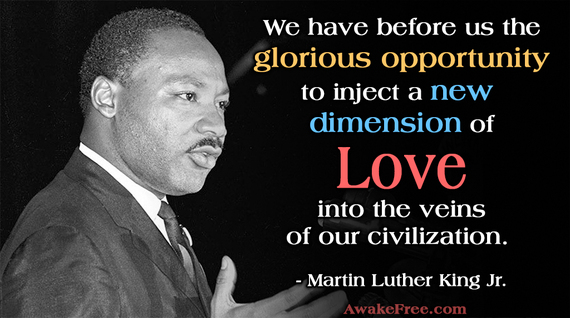
Monday, January 23, 2017

Sermon on the Remembrance of MLK, Jr

January 22, 2017 – 2nd Sunday in Ordinary Time (Year A) & Martin Luther King, Jr Observance (Feast of a Martyr)

Daniel 3:3-18 (abbrev)
Psalm 95
MLK – “breaking the silence” excerpt
Luke 6:35

“If today you hear God’s voice, harden not your heart.” This last week has been a difficult one for many of us. As I started my first week here and experienced the events of the past week – Obama’s farewell, the inauguration, the service of prophetic endurance, the women’s march – and as I sat with the readings for today, I kept coming back to this psalm. If today you hear God’s voice, harden not your hearts.

The UCC – the United Church of Christ – has a branding campaign that reads “God is still speaking.” Something I know and believe to be true. And the Poles have a saying – “Jak trwoga to do Boga” – in hardship, we turn to God – often because we fear god has gone silent and allowed suffering to happen. However, suffering does not mean God is silent. God is indeed still speaking all around us. I am struck by how it is that God speaks to us. Where do we hear God’s voice in today’s world? In this time of despair, of transition, we may be tempted to retreat, to pull back into ourselves, we may struggle to see the work of God, to hear the voice of God, in the world around us. But God is with us always and we are reminded to not be afraid, to not give in to despair. We are not alone in this world, though the troubles may seem overwhelming. God is with us. Just as God was with Shadrach, Meshach and Abednego – giving them the courage and faith to reject Nebuchadnezzar’s idols and gods and to face the furnace. Just as God was with the Rev. Dr. Martin Luther King, Jr – when he rejected the established status quo, when he worked tirelessly for civil rights, when he protested the Vietnam War, and when he was killed for his beliefs and his activism. Just as God was with every single one of the marchers yesterday – here in San Diego, in Los Angeles, in D.C., in Nashville, Boise, and Oklahoma, in cities around the world, marchers committed to intersectional feminism where people of all genders and races can flourish and receive equal opportunities. People young and old, insisting that women’s rights are human rights and human rights are women’s rights. God is with us, my friends. And God is most definitely still speaking.  

The simple fact that God is still speaking is not enough. We all know what it’s like to speak to a room of people and not be heard. To feel that our words have no effect. As Christians, it is our duty to listen for God’s word, for God’s voice, in the midst of the suffering and turmoil. It is our duty to transform those words into action. As Dr. King reminds us, “We, as a nation, must undergo a radical revolution of values.. we must shift from a thing-oriented society to a person oriented society.” We are in need of remembering that we are all beloved children of God. We are relational beings.  The ways in which we interact with each other – the ways in which we thrive – are because of our relationships with each other. Our love for our fellow human beings should mirror the unconditional love God has for each of us. Each and every one of us is a blessed child of God. We are called to make this world one where every child of God can flourish. A world where Black Lives Matter. A world where trans lives matter. A world where people do not live in fear of being deported or of not knowing where they’ll sleep tonight.

Dr. King reminds us that it is not enough just to be the good Samaritan. We must transform the entire Jericho road. We must take a close look at the structures and institutions that allow such suffering to occur. We must listen to the voice of God, listen for it in the world around us, in the voices of the suffering and the oppressed and we must transform it into action.

Like Dr. King, we are called to be prophets, to be witnesses of the radical, unconditional love that Jesus preached. A love that sees difference and diversity as something to be celebrated. A love that lifts up the lowly and the oppressed. A love that inspires us to work in soup kitchens, organize clothing drives, donate to charities, march in the streets. A love that will not stay silent in the face of injustice and oppression. A love that urges us to care for creation because this world is the only one we have to live in and we must preserve it for future generations. This love is neither weak nor cowardly. This is a radical love. A powerful, transformative force that is not willing to let injustice thrive. A love in which we all hold each other accountable. It is the love we hear about in the first letter attributed to John: “Let us love one another, for love is God. And everyone that loves is born of God and knows God. For the person that does not love, does not know God.” “If we love one another, God dwells in us and God’s love is perfected in us.”

We must now take up this calling to love. We must hear God’s voice in the cries and shouts of those who live in fear – in fear of losing their rights, in fear of losing their healthcare, in fear of being deported. The time is now. We cannot sit idly by when the world around us is so clearly in need.

In the words of Dr. King:

Now let us begin. Now let us rededicate ourselves to the long and bitter, but beautiful struggle for a new world. This is the calling of the children of God, and our siblings wait eagerly for our response. Shall we say the odds are too great? Shall we tell them the struggle is too hard? Or will there be another message – of longing, of hope, of solidarity with their yearnings, of commitment to their cause, whatever the cost? The choice is ours, and though we might prefer it otherwise, we must choose in this crucial moment of human history… If we do not act, we risk being dragged down the corridors of time reserved for those who possess power without compassion, might without morality, and strength without sight.

In the nearly 50 years since Dr. King preached these words at Riverside Church in New York City to protest the Vietnam War, our country has changed, but we are still in need of more change. We remain in desperate need of the revolution of values that Dr. King preached.  We live in a world in desperate need of God’s radical and unconditional love and it is up to us to be witnesses and prophets, to live out this calling of love. To continue the good work even though the road may be hard. To not give up, despite the odds. All of us here today are gathered together in love and in God’s name and we are strengthened by that. Strengthened by each other. We must not lose hope. There’s a line in the new Star Wars movie that goes “Rebellions are built on hope.” If we wish to honor the legacy of Dr. King, then we must cling to that hope, we must become that rebellion based on God’s love seeking to transform the world. The hope that is ever present in love. The hope that drives out despair. The hope that remains always. We are a people of love and a people of hope. And we shall not be overcome by the suffering of this world. We shall not be overcome by despair. We shall overcome despair with hope, we shall overcome hatred with love, and we shall keep on keeping on – working in hope, faith, and love until that when justice will indeed roll down live a river.


Amen.

Sunday, November 13, 2016

Called to Justice

Sermon preached at Mary Magdalene Apostle Catholic Community, San Diego, CA on October 23, 2016

Readings: 
Sirach 35:12-17
Psalm: 34:2-4, 17-18, 19+23
2 Timothy 4:6-8, 16-18
Luke 18:9-14


“I have fought the good fight. I have finished the race. I have kept the faith.”

We hear these words from the second letter to Timothy quite often. They’ve become a popular sound byte over the years. And as a former athlete, the metaphor is one that has resonated with me over the years, particularly as I’m still recovering from breaking my leg playing soccer. But these words are more than just comfort after a difficult game or a long race – they serve as both a testimony and a challenge. They echo with a resolute calm as he reflects on his life and faces death.

There is a quiet strength in these familiar words, a resolute faith and certainty in God’s love and justice. And they encourage us to do the same. Over the past two days, I’ve had the opportunity to talk to members of this community and in those conversations I’ve come to see that same commitment to God’s justice and unconditional love. As I look around and reflect on the conversations I’ve had so far and on the stories I’ve heard, I see a community that has fought the good fight and has kept the faith; a community that yearns for and works towards God’s justice. But that is not enough. Because, my friends, our race is not yet over. Our fight continues.

We live in a world where we are faced with injustice at every turn. From systemic racism and sexism that pervades society to the refugee crisis to the various wars that wreak havoc upon our world. We struggle to reconcile the God who is loving and just with the horrors we see in this world. The words from the wisdom of Sirach remind us that we have an ally in God. “God is just and knows no favorites.” (Sirach 35:15) Yet we live in a world rife with economic inequality, where politician ban the arrival of refugees to their states out of fear. We see corruption go unchecked and occasionally even be rewarded and we’re left wondering – where is God’s justice in this?

Where is the God who affirms what is good and right when young black men are being murdered, when LGBTQ youth are more likely to be bullied at school and commit suicide because they cannot envision a world where it gets better? Despite the evil and injustice in the world, I have confidence that God is with us, that the Holy One hears our prayers, but also that we have been called – not just to sit back and be satisfied with the good we have done, but to constantly and ceaselessly work for God’s justice. To create a community where all of God’s children can flourish?

How do we create such a community? In the short time I’ve come to know just a little about Mary Magdalene’s and the people that make up the community here, I’ve come to understand that this is a community that, since its inception, has been founded with a thirst for justice, a hunger to what is right, and to work towards creating the beloved community we so often hear evoke. As Christians, we are called to form beloved communities wherever we are. Communities that go the extra step – to lift up the dispossessed, the marginalized, those who are left outside our doors, outside the margins. We are called to work towards justice, to offer hospitality, to the stranger, to love unconditionally and practice radical welcome – reaching out to those who have faced oppression and discrimination.

In the words of the poet Edwina Gateley: [adapted]

“We are called to say yes
That the kin-dom might break through
To renew and to transform
Our dark and groping world.

We are called to say yes
That black may sing with white
And pledge peace and healing
For the hatred of the past.

We are called to say yes
So that nations might gather
And dance one great movement
For the joy of humankind.

We are called to say yes
To a God who still holds fast
To the vision of a kin-dom
For a trembling world of pain.

We are called to say yes,
To this God who reaches out
And asks us to share
In a crazy dream of love.”

This crazy dream of love is the transformative justice that we are called to participate in. To not be satisfied with the way things are, with the injustice in the world, with the status quo. Let us not become like the Pharisees in Luke’s account, resting on our laurels and praising our actions and good works. It is not for us to make that call. We are called to seek truth and justice boldly, to be disturbed and discomforted by the injustice, oppression, and exploitation of people; to tirelessly work for justice, freedom, and peace. To stand in solidarity with those who suffer and struggle, to work to change oppressive structures and systems that perpetuate the sins of sexism and racism, of homophobia and transphobia.

The race we hear about in the second reading is not a sprint, it is a marathon relay that we as Christians have been called to run and to work at generation to generation. As Martin Luther King, Jr., Thomas Parker, and Barack Obama have said – the arc of history is long but it bends towards justice. However, it will not get there without our help. We must keep working to transform our world, to create communities where the suffering and persecuted are not only welcomed, but supported and encouraged. We are called to transform the world we live in – but to do so humbly, always seeking God’s justice in all that we do and everywhere we are.


We have kept the faith; we have fought the good fight. But we must keep on because our race is far from done. Amen.

Sunday, March 2, 2014

Transfiguration & Transformation: to repair with gold

Preached on Wednesday, 26 February 2014 at Diocesan House, Episcopal Diocese of Connecticut, feast of the Transfiguration (last Sunday of the Epiphany)

Readings:
[Exodus 24:12-18]
2 Peter 1:16-21
Matthew 17:1-9


As Episcopalians, we’re fortunate enough to get to celebrate the Transfiguration twice in our liturgical year - once on the last Sunday before Lent, often known as Transfiguration Sunday, and then again on August 6, the Feast of the Transfiguration.  It’s nice today to think about August – about long summer days and even sweltering heat as we feel the brunt of another ‘polar vortex’, but there is something peculiar, and special about Transfiguration Sunday.

Today’s transfiguration comes at the end of the season of the epiphany, at the end of a long and particularly arduous winter, on the threshold of lent. This year, Christmas and Epiphany seem like long forgotten memories, buried under the snow and ice that have been a near constant presence. There is a hope that spring lurks just around a corner, but on a day like today, spring shows no sign of hurrying. Liturgically, we are at a threshold, or, as one of my priests calls it, a hinge day. A hinge between the seasons of epiphany and lent, but more than that, a hinge between heaven and earth. That’s what we glimpse at the transfiguration, a disruption of the norm and a supernatural event that causes fear in the disciples.

In the icons of the transfiguration, Jesus is usually depicted standing between Moses and Elijah, enshrined in gold and light on the mountaintop with rays of light emanating force, piercing the disciples. In contrast, Peter, James and John are shown lying down or with their faces turned away. We glimpse a moment of liminal space, a moment of transition and transformation and we become acutely aware that something is happening. Something is happening and we are invited to be transformed.

In the first reading, we are called to be attentive to the prophetic message, “as a lamp shining in a dark place” until the day dawns and the morning star rises in our hearts. There is a feeling of waiting, of expectation, of hope in spite of the darkness. Peter, James, and John needed this hope. Six days earlier, Jesus had told his disciples that he would be handed over to the chief priests, killed and raised up on the third day. Difficult news for anyone to swallow. It is not difficult to imagine the sort of darkness the disciples were living in – having to come to grips with the revelation that their beloved teacher would be taken from them and killed. At the same time Jesus was asking them to take up their cross and follow him. We can imagine the feelings of fear, hopelessness, betrayal…through this, Jesus asks his disciples for acceptance of what is to come.

And now, Jesus takes Peter, James and John with him up on a mountain, apart from the others and is transfigured before them – as if they didn’t have enough to deal with. But this clearly supernatural event only gets better. Out of nowhere, Moses and Elijah appear, talking with Jesus and then a voice emerges from the heavens, “This is my Son, my Beloved, with whom I am well pleased, listen to him.” The disciples naturally fall to the ground in fear and it is Jesus who rouses them, reassuring them and telling them to not be afraid. It might not be only fear that causes the disciples to fall down and turn away, but the knowledge and awareness that they are participating in something greater, something beyond their wildest imagination. They know they are being invited into transformation.

Who are these words from heaven for? In the disciples, they seem to cause more fear than anything. Perhaps it is Jesus himself who needs to hear these words, this reassurance of his father’s love, of approval, of his mission. Despite the supernatural nature of the transfiguration, perhaps this is a moment where we see Jesus’ humanity bleed through. Aware of the task before him, the difficulty of accepting what he is called to do, he takes some of his friends and goes up on a mountaintop to pray. And what is the result? Two of prophets come to speak with him and his father’s voice booming from the heavens.

We know what comes next. The forty days of lent, the triumphal entry into Jerusalem on Palm Sunday, the last supper, the crucifixion and eventually the resurrection. But let’s not get ahead of ourselves. Let’s take a moment to stand here on the mountaintop, to consider our own selves on the brink of transition – transition into a new liturgical season and transition into a new space for our work. Transition is scary. New things are scary and often hard. Sometimes we don’t feel ready for the change, something we feel that we are incapable of bearing it. We so easily forget that the journey up the mountain, the journey into the wilderness, can carry with it the potential for transformation.

In Japanese, there is a word called kintsukuroi, which means to repair with gold. It was a word that came into mind when I read over today’s Scriptures, a word that refers to the art of repairing broken pottery with gold and silver lacquer and understanding that the pottery is more beautiful for having been broken because it is precisely those broken shards that allow the luminescent gold to show. This fits in with the transfiguration. The disciples were not perfect people. These were ordinary individuals, each with their faults, each asked to take up their cross and follow Jesus. Asked to leave behind their family and their possessions and enter into this journey with Christ. We, too, are invited into that journey, into the moment of the transfiguration. How will we let Christ transform us? How will we let him repair our brokenness with gold so that we are more beautiful for it?


Wednesday, February 13, 2013

Ash Wednesday or A Year in the Wilderness


A year ago (liturgically), I lost my job. A job that had seemed perfect on paper – advocating for sexual health and reproductive justice within a religious context. Being a voice for progressive religious organizations in a multi-faith context. Sure, the location wasn’t ideal, but I was willing to make it work for this amazing opportunity. I lost the job only a few weeks after getting it due to financial circumstances for the organization that were beyond anyone’s control. I lost my job on Ash Wednesday, a few weeks before I was set to go to Israel and Palestine for the second time to attend a conference on the conflict. As someone who, for better or worse, makes sense of their life liturgically and theologically, it was as if I had been thrown into the wilderness with no support. I remember calling my parents in tears, texting my roommate, waiting for my aunt & uncle to come home so I could tell them. It was nothing I did and yet I felt like an incredible failure. It was a month before my thirtieth birthday and I was, once again, unemployed.

The weeks I had at that job were amazing and stressful. I learned I didn’t hate policy as much as I thought I did, I learned the fast-paced environment of responding to current events and legislation sated my adrenaline junkie. I learned how to spin information for social media and I got the chance to work with some really amazing people. And I will never forget the moment of “White House on line one, New York Times on line two” that made me realize what we were doing mattered.

A year later, on Ash Wednesday, I am once again unemployed. I have come in second and third for some amazing jobs that went to equally amazing people. I have worked temp jobs, babysat. I’ve now applied for graduate school (again) and I keep searching, hoping, praying, to find that opportunity that will lead me out of the wilderness, out of the cloud of unknowing.


There have been moments of respite, certainly, but it often feels like much of the past year has been spent wandering in the wilderness, with clarity about vocation simply a mirage that disappears when I try to get close. It has been a struggle in discernment, trying to juggle finding a way to pay the bills alongside finding where God is leading me. There were (and are) numerous times I have felt lost and hopeless, wondering at what point perseverance becomes stubbornness and obstinance?

I have been blessed to have incredible support from family members who have tried to give me the space to struggle and wander while keeping up the guise of independence, but such things cannot last forever and as financial concerns weigh more heavily on my mind I’m torn between trying to follow my dreams against all odds and just giving up. The wilderness is a struggle. There are overwhelming temptations, but what is worse to me, is the length of time one can be in the wilderness. If one knew when the end was, if it was a finite amount of time, it would be easier to bear. But the indeterminate wilderness? I don’t enjoy it. (Yes, I realize you’re not supposed to enjoy the wilderness). I don’t like not knowing when something will end, especially when each series of cover letters and resumes and applications seem like exercises in vulnerability, trying to sell myself while putting myself at the mercy of others. I want more control than that. I want boundaries on my wilderness. I want to know that this too shall pass and ‘All shall be well, and all manner of things shall be well.’ Because the longer the wilderness goes on, the greater the doubt, the notion that my vocation is just an illusion I’ve created in my head.

Last Lent, I had the privilege to stand on the edge of a sand dune in the Judean desert, eyes closed, sun setting as a Minister read the account of Jesus’ temptation in the dessert. I was overwhelmed to be in this spot, to have my surroundings match my mental and spiritual state. Glancing around there, I saw how easy it would be to get lost in the desert. As I enter into Lent this year, I feel the need to remind myself of the end of the story, “Then the devil left him, and suddenly angels came and waited on him” (Matthew 4:11). Somewhere, sometime, this wilderness will end and I can only hope there will be angels there for me.

Tuesday, October 16, 2012

It's Too Soon to Say Goodbye

My parish church (Christ Episcopal Church in Somerville, Massachusetts), closed this past Sunday. In many ways, it still doesn’t feel real. This is the second parsh that I’ve been a part of that has closed in the last three years, which makes it difficult on more levels. Foolishly, I thought the second time would be easier. I knew what to expect, I’d done this before. But like the death of a loved one, it doesn’t become any easier just because you’ve experienced it before. I came back from a trip to Poland four weeks ago and it was then I found out that our last service would be October 14. I panicked. It was too soon. I wasn’t ready. I wasn’t prepared. I wanted one last Halloween party for the residents of the Walnut Street Center – one last opportunity to wear a costume to church on Halloween morning. I wanted to preach in this community one last time. I wanted more time. But we don’t always get what we want.

I’d only been a part of this community a few years ago after my last church closed. I wasn’t a lifetime member like others in the congregation. I haven’t even been there every Sunday for the past few years because life’s adventures took me to many different places and family obligations meant I was often out of town for Sunday mornings. And yet even when I was spending a summer studying in Western Massachusetts, I found myself coming back to Somerville to this small faith community. This was home. I might have jokingly referred to it as an ‘Island of Misfit Toys’, but it is a place that always welcomed me with open arms. There were plenty of times I felt like the prodigal child, going off to search for a community that was more sustainable, larger, less quirky – but church shopping isn’t easy even at the best of times. No matter what, no matter how long I was gone, there would always be someone to welcome me back with open arms. I remember one Sunday, walking into the church and having one of the young adults run down the aisle to give me a big hug and tell me how much they’d missed me and how happy they were to see me. That’s home. The place you can always come back to, where you can leave your troubles at the door and just rest in the presence of those who love you. That’s what Christ Church was to me. Home.

Sometimes you find home in the most unusual places. I was fortunate enough to live walking distance to Christ Church but I don’t think I ever expected what I found there. I underestimated the community and the unconditional acceptance and radical welcome I found in that small community. It might not have been the great big stone church with beautiful rose windows that I saw in my head, but it in life I think you have to be willing to see God in unexpected places. I had hoped that Christ Church would be able to put me forth for ordination, but God apparently has other plans.

Christ Church Somerville has long been referred to as the Dandelion of Somerville. Children in their innocence pick dandelions to present them to people as beautiful flowers. What may be a weed to some can be a beautiful flower to others. Like a dandelion, Christ Church is sending us out into the world, wherever the wind will carry us. There are things I wish I could change. I wish I could have spent more time at Christ Church, gotten to know people better, etc., but it was what it was. I know that I am blessed to have been a part of Christ Church and to have found a spiritual home for these last few years. It’s always hard to say goodbye and it feels like this goodbye came much too soon, but perhaps it is “better to have loved and lost than never to have loved at all.” I loved Christ Church, I loved the welcome I found there, the opportunities to preach, to laugh, to learn. But all good things must come to an end. It is enough to cherish the time we had, to be grateful for the opportunities, and to be fortified as we go forth like dandelion seeds blown about helplessly on the wind. But even a small dandelion seed can sprout in the cracks between the concrete sidewalk. Thank you for the memories Christ Church, because I knew you, I have been changed for good.

“There are no goodbyes for us. Wherever you are, you will always be in my heart.”
― Mahatma Gandhi


Thursday, June 21, 2012

Changing of the Guard - In Memoriam

It’s been over a month since my grandfather died and I started writing this blog post which falls somewhere between an attempt at a eulogy and a theological reflection, not only on my grandfather but on death itself. But with father’s day, it seems a good time to get this finished and posted. First, a bit of backstory:

On Thursday, May 3, I got the news that my grandfather was in the hospital and that it was fairly serious so I made plans to drive down to Connecticut that weekend. The following day, the news was worse – the doctor said my grandfather probably only had a few days left in this life. Friday night my mother called me from Connecticut and simply said, “I need you.” My plan had been to come down Saturday evening after some events I had scheduled, but now things had changed. I’d be leaving first thing Saturday morning and picking up my brother from the airport along the way. From the moment I spoke to my mother until I got to the hospital, the words of the Song of Simeon kept replaying themselves in my mind: “Lord, let thy servant now depart in peace.” My grandmother had passed away two years ago and I knew my grandfather had been incredibly lonely since then. At that moment, all I could do was pray for a peaceful end to his suffering. It wasn’t an entirely selfless prayer – while I did long for an end to my grandfather’s suffering and peace for him, I also wanted to stop watching him suffer. His health had deteriorated quite a bit since Christmas and I couldn’t bear to watch it.

When I arrived at the hospital and greeted my grandfather, the words in my head changed. I looked at my grandfather, lying there in the hospital bed, kept comfortable with morphine, surrounded by children and grandchildren and only the following two sentences popped into my head:

“I relieve you.”
“I am relieved.”

The words popped into my head from the Star Trek (2009) film, but what connection was there between a sci-fi film and my grandfather dying? Not much. But the exchange didn’t originate with Star Trek – it comes from the military. These words signify the changing of duty – when one officer takes over for another. Simple sentences that signify that a person is no longer on active duty, they are free to do something else. I began to contemplate the significance of these words in the current situation. What does it mean to be “relieved” and can we apply this to the end of life?

Maybe that was it – maybe my grandfather was finally going to be relieved of all his pain and suffering. We use the word “relieved” often in our lives, but does it mean what we think it means? It’s a word that has become commonplace. As a student who might not have always been prepared for class, I was relieved when a teacher didn’t call on me on days when I was unprepared. As a young professional in these economic times, I am relieved when there is enough money in my bank account to cover this month’s bills or when I land a job, even if it’s not the one I want. But I wonder more about a different type of relief. The eternal relief that comes with death is something beyond our imagination. It is that moment when all our cares and troubles go away. There is no more worry, pain, stress, or anticipation. This is the relief I believe my grandfather felt in his last few days – surrounded by family, with morphine to dull the pain, he passed in the night with my mother holding his hand.

It’s the ultimate changing of the guard – all four of my grandfather’s children are already grandparents themselves and now they have become the elders of the family. It’s the beginning of a new order, in a way, but one that values the tradition it came from and seeks to integrate it into the culture we live in. Maybe that’s why the words occurred to me, but I wonder if there was something more – some deeper connection to my grandfather’s military past.

My grandfather was a Polish veteran, who served in the Polish Underground Army during World War II, so the phrase seemed fitting. Moreover, in the hospital, the directive was simply to keep my grandfather as comfortable as possible because his kidneys had shut down and there was fluid in his lungs. When I saw him, lying in that hospital bed, there was sorrow, but there was also relief. After two years of sadness, loneliness and deteriorating health, he’d be joining my grandmother in the afterlife, and I believe he was relieved that his journey would be coming to an end. He’d lived a long full life in his 92 years and seen the birth of seven great-grandchildren. He’d fought for the freedom of his country and achieved the American dream. He’d been married to my grandmother for over sixty years.

My grandfather didn’t speak of ‘the War’ (WWII) often because there were too many painful memories. Reflecting on his life, it’s highly likely he suffered from PTSD, undiagnosed and untreated. He coped in our family’s traditional way – you just keep going. He rarely spoke of his time in the military and he was probably grateful his sons weren’t called up for the draft during the Vietnam War, but he took great pride in being a Veteran. He was active in two Veteran groups in New Britain, Connecticut and took the children and grandchildren with him to events whenever possible. His life with the Veteran’s group was something we knew little about, other than he rarely missed a meeting. Perhaps they provided him with the support he needed as a survivor of the horrors of World War II, perhaps they understood what he went through in a way we never could (and maybe he never wanted us to). I didn’t realize just how esteemed he was by the Veteran’s groups until his funeral. Both Veteran’s groups were there in uniform – over fifty Polish veterans and auxiliaries. Two stationed themselves as an honor guard to my grandfather’s casket and one my one they came and saluted the casket. My grandfather had been a leader among them and well-loved and honored. As I stood there in my Polish Scout uniform receiving their condolences (somehow at the front of the line), I felt simultaneously honored and unworthy. Who was I to receive condolences from these people who were braver than I could imagine, who had seen horrors I’d only read about, who had survived concentration camps? They had fought for freedom and had moved to the US for a better life, just like my grandfather. I was the product of that. Perhaps the changing of the guard wasn’t just the passing of the torch from my grandfather to his children, but passing it also to the grandchildren. We are his legacy, and while I don’t feel ready to inhabit that, I know that in time, I will. “If we are willing, God will make us ready.”

When I stood in the corner of that hospital room and prayed silently the Song of Simeon as well as the Litany for the Dying, I could imagine Jesus coming to stand at the foot of my grandfather’s bed and saying “I relieve you.” My grandfather’s duty on earth was finished and now it was time for someone else to take over. After all, the bible has Jesus saying “Come to me all who are weary and I will give you rest.” What greater rest, what greater relief, is there than life eternal with the one we love and who loves us unconditionally?

Albin Sypko 1920-2012

Friday, April 6, 2012

Betrayal: Judas Iscariot and Simon Peter

Good Friday (Year B) sermon preached at Christ Church Somerville on 6 April 2012, the Rev. Christopher Fike presiding.

“Now, O Lord, take my lips and speak through them;
Take our minds and think through them;
Take our hearts and set them on fire with love for Yourself, Lord Jesus. Amen.”


During Holy Week, it’s often easy to focus on Judas Iscariot’s betrayal. Here is a man who seems to be predestined to betray Jesus and set the crucifixion in motion. He was one of the twelve and I can’t help but wonder if Jesus knew from the beginning, from the moment he met Judas, that Judas would betray him? I can’t imagine trying to live that knowledge. Judas’ betrayal has been a topic of theological discussion for centuries – did Judas have a choice? Could Judas have said no? Was there a way out for him or was he always predestined to betray Christ? Was he simply an actor in a play – given a crucial instrumental yet undesirable role essential to the plot? There are no clear cut answers to these questions but it doesn’t hurt to take and moment to consider what might have happened had Judas not betrayed Jesus. Would another one of the twelve fulfill that role? Without the crucifixion, there can be no resurrection and without betrayal, there can be no redemption.

In John’s gospel, Judas doesn’t betray Jesus with a kiss. Instead he arrives at the garden with armed soldiers in tow, seemingly aware of what he is doing. John doesn’t tell us what happens after that — Judas’ role is complete. He was the catalyst, his role is done, there’s no need to have him in the story any more.

I’d like to take us back to an earlier point in John’s gospel that wasn’t in tonight’s selection where he discusses the betrayal of Judas in Chapter 13(21-30):
After saying this Jesus was troubled in spirit, and declared, “Very truly, I tell you, one of you will betray me.” The disciples looked at one another, uncertain of whom he was speaking. One of his disciples—the one whom Jesus loved—was reclining next to him; Simon Peter therefore motioned to him to ask Jesus of whom he was speaking. So while reclining next to Jesus, he asked him, “Lord, who is it?” Jesus answered, “It is the one to whom I give this piece of bread when I have dipped it in the dish.” So when he had dipped the piece of bread, he gave it to Judas son of Simon Iscariot. After he received the piece of bread, Satan entered into him. Jesus said to him, “Do quickly what you are going to do.” Now no one at the table knew why he said this to him. Some thought that, because Judas had the common purse, Jesus was telling him, “Buy what we need for the festival”; or, that he should give something to the poor. So, after receiving the piece of bread, he immediately went out. And it was night.

John presents us with a Judas taken over by Satan: “After he received the piece of bread, Satan entered him.” Is it God who is the architect here, assigning roles to the various players? John’s gospel makes no mention of Judas being paid for betraying Jesus and no mention of suicide; only Matthew’s gospel account deals with what happens to Judas after he betrays Jesus. We’re left to speculate what happens to Judas but we often just run with what we read in Matthew. We understand Judas as a man who is consumed by guilt and regret after he betrays Jesus, who attempts to return the money he was paid for his deed, and who goes and hangs himself in a field.

We know so little about Judas yet we all know who he is. At times we vilify him, calling any traitor a Judas. If we think Judas was nothing more than a pawn in the passion narrative, we pity him, but we can easily forget that Judas’ betrayal is not the only one in the passion narrative. After Judas leads the soldiers to the garden where Jesus is, Simon Peter fulfills Jesus’ other prophecy about betrayal, denying Jesus three times. Moments after cutting off a slave’s ear in an attempt to protect and defend Jesus, Peter is overcome with fear and denies having anything to do with Him. Two of the hand-picked twelve have now denied Jesus.

And so I find myself asking are Judas Iscariot and Simon Peter really so different from each other? Judas who becomes branded a traitor for all time and Simon Peter who gets chosen to feed Jesus’ sheep and becomes the rock of the church. It seems these two could not be further from each other but I believe they’re not as different as we think. Both of them are overcome by fear, both of their betrayals are foretold — what changes? What makes one an infamous traitor and the other a saint and founder of the church is what happens after the betrayal.

Each of us, at some point in our lives, has betrayed or denied something or someone. It may been something small and minor or it may have been something larger, something we greatly regret. What do we do after that betrayal? Do we, like Judas, sink into despair and let ourselves be overcome by it or do we instead allow ourselves to be overcome by love and forgiveness, allowing grace to work in our lives and becoming better people, learning from our mistakes. The choice is ours — the opportunity for forgiveness and grace is always there.

Both Judas and Peter betrayed the man the loved, the man they gave up everything to follow the man they believed to be the Messiah, the son of God, yet their stories go in opposite directions. After Peter’s betrayal in John’s gospel, we see nothing more of him until Mary Magdalene runs to him on Easter morning to tell him that Jesus has disappeared from the tomb. No mention is made of Peter being present at the crucifixion. What can we make of this? Did Peter spend the weekend in despair wondering if his denial affected the outcome, wondering if he’d just ruined his chances? Peter might have been consumed by despair but nonetheless he waits and is able to see the empty tomb on Easter morning.

Judas, according to Matthew’s gospel, regrets his actions so much that he tries to return the money he was paid. He fears he has damned himself and believes that he is beyond any redemption. He has just betrayed his teacher, his Lord and will be forever blamed as one of the figures responsible for Jesus’ death. Even though he was among the twelve whom Jesus told he would and rise again, Judas gives into the despair and hopelessness. He sees no way out and he takes matters into his own hands. He can’t see beyond his actions, he can’t see the presence of God and he gives up – he kills himself, ending any chance of seeing Jesus’ resurrection. But what would have happened if he didn’t? What if Judas had waited? What if he had managed to see the resurrected Christ? I believe that Jesus would have embraced him and forgiven him. If I believe in God’s grace and unconditional love, I have to believe that Jesus would forgive him and be reconciled with him, just like he was with Peter. Perhaps Judas would have become the rock upon which the church was built. Anything is possible.

As we meditate on the death of Christ, let us take a moment to consider our own denials and betrayals. Where is it in our lives that we turn away from God, refuse to be associated with him? More importantly though, how do we respond? Are we Judas Iscariot or Simon Peter? Do we let ourselves become consumed by guilt and despair, giving up on hope and thinking ourselves beyond grace and redemption? Or do we manage to be like Peter, holding on through the unknown, believing in God’s faithfulness and grace? I think we all have our Judas moments, but the important thing is not to let ourselves be consumed by them.

Almighty God, we ask you to look down graciously upon us, for whom our Lord Jesus Christ was willing to be betrayed and to suffer death upon the cross and whose death we commemorate today. Be with us today as we stand at the foot of the cross and behold our Saviour upon it. Amen.

Wednesday, April 4, 2012

A Life Divided

The journey of Holy Week continues as we rapidly approach the Triduum, my favourite time of the liturgical year. My previous post reflected on being willing to follow God’s will and how God will make us ready. Today’s picks up on a similar theme and started when a friend from high school emailed me the following quote:

”One who is content in what he has, and who accepts that [one] inevitably misses very much in life, is far better off than one who has much more but who worries about all s/he may be missing. For we cannot make the best of what we are if our hearts are always divided between what we are and what we are not.”
-Thomas Merton


This quote brought me to tears instantly, hitting me like a ton of bricks, particularly the second sentence: “We cannot make the best of what we are if our hearts are always divided between what we are and what we are not.” The quote seemed to mirror where I am in life — afraid to commit, to try for things because of the “what ifs?”. I’ve been burned recently and I’m just not sure if I can take that risk. If I commit to one thing, does that close the door on other possibilities and opportunities? I’m here in a self-imposed whirlpool of angst and indecision while each successive day only makes it worse.

Acceptance is the key to the first part of that quote. I’d take it one step further; it’s not enough to simply accept God’s will for our lives, to accept the path God is calling us to, we need to also embrace it. We need to say yes, to take the step forward and embrace the possibility. The second part of the quote, “We cannot make the best of what we are if our hearts are always divided,” seems to tie in well with another Thomas Merton quote that reads, “A life is either all spiritual or not at all. No [hu]man can serve two masters. Your life is shaped by the end you life for. You are made in the image of what you desire.”

A life divided is a life not lived out to the fullest. God wants us to flourish. God loves us unconditionally and has plans for us, plans to use our talents to our fullest potential. Our hesitation can prevent that, it can keep us from fully experiencing the love and joy of God — to be surrounded and even overwhelmed by that unconditional love. It scares us because it is beyond the realm of human experience. Can we even conceive of God incarnate embracing us, kneeling down to tenderly wash our feet, taking away all our fears, insecurities and sins, leaving us with a feeling of pure, unadultered love? I can’t. Not easily. The simple thought of it threatens to bring me to tears.

God does not ask us to do the impossible. God only asks us to give ourselves wholly to the possibility of what S/He might have in store for us. It is like a dance. To stand at the edge, listening to the music, feeling that tug, moving slightly to the music, but not quite participating. When God stops in front of us and holds out a hand in invitation, it is up to us to take it, to join in and get swept up in the whirlwind of the dance. We cannot worry about what others will think, of whether we’ll know the steps or not — there is no need to worry. God will lead us in the dance and we only need to follow, to let ourselves be spun around and grasped firmly in a loving, secure embrace before we spin out of control. Dancing is about trust, about letting go, trusting that your partner won’t drop you when they dip you, lift you, or flip you. Trusting that you won’t slip and fall —but if you do, God will be there to pick you up because the dance goes on.

When I was home for joint birthday celebrations two weeks ago (my grandfather’s 90th and my 30th), there were various pre- and post- parties at my parents’ house. During one of them, my cousin decided to change the music to something more danceable. I seized the opportunity and asked him to dance since he’d been the one to switch the music. After a bit of hesitation, he took the opportunity to lead me in a fast whirling, spinning dance to the music of Motown. There were a few near misses since we don’t get a chance to dance together often, but we quickly fell into sync, twirling around the living room like we’d always been doing this — as usual, I was barefoot. We hadn’t rolled up the rug beforehand as is custom in my parents’ house before the dancing begins and I joked I’d have rugburn on the bottoms of my feet from dancing barefoot, but I didn’t care. In the moments of the dance, I didn’t care about anything else —I couldn’t worry about the fact that I didn’t have a job or any of the other concerns weighing on my mind. Everything else disappeared because I needed to be fully present in the dance – to be led and twirled and dipped. At the end of the dance, there was no worry, no fear, no discontent. All that was left was the exhilaration and overwhelming joy of the experience. That is what I want for my life, for my relationship with God — an exhilarating, overwhelming, joyful experience dancing in the whirlwind.

I don’t want a life divided, I don’t want a life half-lived. I take this moment, on the eve of the Triduum, to say yes. Yes to the unknown. Yes to the possibilities. Yes to the mad, crazy, wonderful dance. I suspect that God will lead me to something beyond my imagination. I say yes.

As we approach the holiest days of the years, perhaps a bit of reflection is in order —what is got calling us to? Are we willing to end the division in our hearts and follow God wholeheartedly?

If we are willing, God will make us ready

It’s been a bit of a dry spell on this blog lately, but then there isn’t always much water in the wilderness. On Palm Sunday, I was fortunate enough to attend services at ”St. Paul’s Newton Highlands for a Passion service with music from JC Superstar (which is one of my personal Lenten traditions). For the vocals, St. Paul’s did a gender and age blind casting which I appreciated and interwove narratives from scripture with the songs from JC Superstar to craft a cohesive passion story. Hearing one of my favourite musicals in the context of a mass brought together two of my loves and made the service that much more meaningful. It was exactly what I needed. The liturgy was punctuated by a refrain from another of Andrew Lloyd Weber’s musicals – a modified version of “Close Every Door” from Joseph and the Amazing Technicolor Dreamcoat that went as follows:

Close every door to me, taunt me and torture me
Bar all the windows and shut out the light.
Do what you must with me, from dust to dust with me,
I’ll stay the course through the day and the night.
If my life were important, I would ask will I live or die,
But that’s not the question, the answer is love.
Close every door to me, throw stones and more at me,
Children of mercy/justice/freedom are never alone.
For we know we shall find, what God has in mind,
For we have been promised that we are God’s own.
-modified by Gretchen Grimshaw


The presentation of the Passion narrative was moving, but it didn’t prepare me for being blown away by Rev’d Gretchen Grimshaw’s sermon. The line that stuck with me most was “If we are willing, God will make us ready.” How many times do we plead unreadiness or unworthiness when responding to Gods call? As a child, I was taught that God answers our prayers in one of three ways: Yes, No, or Not yet. Do we give God the same responses?


I know there have been times when I’ve given God a very loud and resounding “No! Absolutely, positively not!” Have I moved away from that to a response of “Yes, but…”? I feel as though I’m trying to negotiate with God. Is that even possible? I want to be willing, I want to say yes, but I’m scared. I’m scared of what God will ask of me, I’m scare of what I might have to give up. I’m afraid of the unknown and yet at the back of my mind, I believe that saying yes wholeheartedly and accepting God’s invitation is the only way out of the wilderness. Mark’s gospel tells us that the angels were waiting for Jesus at the edge of the wilderness — are there angels waiting for me? Sometimes I think that it is my reluctance —my hesitation— that keeps me in the wilderness. Why should I hesitate to leave the wilderness when I don’t like it here — it’s difficult and I feel I’m approaching my wit’s end. Still, I can’t seem to give God an unconditional yes. I keep trying to arrange things my way. I know that no one except God can guide me out of this wilderness and all I have to do is say yes. But I can’t or I won’t. Though my friends, family, and mentors want to help and might be able to point me in the right direction, it’s up to me to take that step, to take God’s outstretched hand and say, “Yes, I love you, God. I choose you. Yes, I am willing.”

It’s often easier to say yes in the goodtimes. In the wilderness when we feel like Job — drained, spent, exhausted and with nothing left to give — we can find ourselves reluctant to say yes to the unknown because we feel we can’t endure much more. I find myself hesitant to relinquish the few things in my life that still give me security. “Freedom’s just another word for nothing left to lose.” I feel I’ve lost so much this Lent that I’m reluctant to risk anything else. Instead of taking that step, taking God’s outstretched hand, I want to just curl up and attempt to comfort myself. It’s a hollow comfort but at times I nonetheless insist on it.

When God holds out that hand, I stammer and sputter, reluctant to take up the offer. All my knowledge and belief in a loving, supportive, and benevolent God flees in the face of fear. I insist on my lack of readiness and my unworthiness, claiming I won’t be able to do what God is asking me despite the fact that I hear God telling me, “I have made you worthy and I will make you ready. All you have to do is say yes.”

I want to say yes, but I’m not ready. My heart yearns for God’s embrace, but I’m dragging my feet. Today I still say “Not yet” and “Yes, but…” My impulsive streak wants to say “Forget it all. Why the hell not?” That isn’t equivalent to an unconditional yes though. There’s a difference in agency, in will. One seems to be an end to resistance, an acceptance of inevitability, almost akin to being an accomplice by association. But God asks us for more. A “yes”, freely and unconditionally given, seems predicated on an act of will and agency —it is a choice and an action. It is not simply a resignation and acceptance of something inevitable, it is choosing and moving towards that direction, towards God. It is the difference between active and passive. I’m not sure if there’s value to the “Why not?” response or if it’s closer or further from a firm “YES” however, I think (and hope) that I’m moving towards that unconditional yes and God’s unfaltering patience with my stubbornness comforts me. I can’t say yes just yet, but I’m inching in that direction, towards the unknown and out of the wilderness. If I am willing, God will make me ready.
-written 2.IV.2012