Monday, March 13, 2017

Transforming Fear into Love


March 12, 2017
2nd Sunday of Lent
Excerpts from Exodus 24 & 34
Psalm 83
2 Timothy 1:8-10
Matthew 17:1-9

“This is my Beloved, with whom I am well pleased.” When the disciples hear these words coming from heaven, they are overcome with fear. Moments ago, Peter had been ready to put up three tents on this mountain – one for Jesus, one for Moses, and one for Elijah. And now, Peter, James, and John are lying on the ground in fear… until Jesus reminds them: “Do not be afraid.” In the blink of an eye, Peter has gone from the confident planner to being paralyzed with fear. And that’s not that hard to image. Fear is powerful. Paralyzing at times. Fear can take many forms in our lives. It can stop us from speaking out, for fear of retribution. It can keep us suffering in silence, unwilling to ask for help. Fear is powerful and often illogical.

In today’s readings, fear meets its match, its kryptonite, as it were. Grace.

Grace that manages to break through the normal and the everyday. That’s what we glimpse at the transfiguration, a disruption of the norm and a supernatural event that causes fear in the disciples. In the icons of the transfiguration, Jesus is usually depicted standing between Moses and Elijah, enshrined in gold and light on the mountaintop with rays of light emanating force, piercing the disciples. In contrast, Peter, James and John are shown lying down or with their faces turned away. We glimpse a moment of liminal space, a moment of transition and transformation and we become acutely aware that something is happening. Something is happening and we are invited to be transformed from fear to love.

In the first reading, we hear about another mountaintop. A mountain where Moses, Aaron, Nadab, and Abihu saw God, ate, and drank. A mountain where Moses spent forty days and forty nights before receiving the words of the covenant. And maybe we too long for a mountaintop. A place where we could go and see God face to face, to ask those burning questions that besiege us.

In this season of Lent, there’s a feeling of waiting for the inevitable. A feeling of hope in spite of the darkness. Peter, James, and John needed this hope. Six days earlier, Jesus had told his disciples that he would be handed over to the chief priests, killed and raised up on the third day. Difficult news for anyone to swallow. It is not difficult to imagine the sort of darkness the disciples were living in – having to come to grips with the revelation that their beloved teacher would be taken from them and killed. At the same time Jesus was asking them to take up their cross and follow him. We can imagine the feelings of fear, hopelessness, betrayal…through this, Jesus asks his disciples for acceptance of what is to come.

And now, Jesus takes Peter, James and John with him up on a mountain, apart from the others and is transfigured before them – as if they didn’t have enough to deal with. But this clearly supernatural event only gets better. Out of nowhere, Moses and Elijah appear, talking with Jesus and then a voice emerges from the heavens, “This is my Beloved, with whom I am well pleased, listen to him.” The disciples naturally fall to the ground in fear and it is Jesus who rouses them, reassuring them and telling them to not be afraid. It might not be only fear that causes the disciples to fall down and turn away, but the knowledge and awareness that they are participating in something greater, something beyond their wildest imagination. They know they are being invited into transformation.

Who are these words from heaven for? In the disciples, they seem to cause more fear than anything. Perhaps it is Jesus himself who needs to hear these words, this reassurance of God’s love, of approval, of his mission. Despite the supernatural nature of the transfiguration, perhaps this is a moment where we see Jesus’ humanity bleed through. Aware of the task before him, the difficulty of accepting what he is called to do, he takes some of his friends and goes up on a mountaintop to pray. And what is the result? Two of prophets come to speak with him and his father’s voice booming from the heavens.

We know what comes next. We continue our journey through lent leading to the triumphal entry into Jerusalem on Palm Sunday, the last supper, the crucifixion and eventually the resurrection. But let’s not get ahead of ourselves. Let’s take a moment to stand here on the mountaintop, to consider our own selves on the brink of transition and transformation. Out of fear and into love. Be not afraid. New things are scary and often hard. Sometimes we don’t feel ready for the change, something we feel that we are incapable of bearing it. We so easily forget that the journey up the mountain, the journey into the wilderness, can carry with it the potential for transformation.

Touched by an Angel,
Maya Angelou

We, unaccustomed to courage
exiles from delight
live coiled in shells of loneliness
until love leaves its high holy temple
and comes into our sight
to liberate us into life.

Love arrives
and in its train come ecstasies
old memories of pleasure
ancient histories of pain.
Yet if we are bold,
love strikes away the chains of fear
from our souls.

We are weaned from our timidity
In the flush of love's light
we dare be brave
And suddenly we see
that love costs all we are
and will ever be.
Yet it is only love
which sets us free.


Thursday, March 9, 2017

Desert Wilderness

5.III.2017
First Sunday of Lent Year A
Genesis 2:7-9, 15-22, 3:1-7
Psalm 83 (Nan Merril) Stanza One
1 Thessalonians 3: 4-9, 12
Matthew 4:1-11

As we begin our Lenten journey today, we hear about Jesus being led into the wilderness for forty days and forty nights in the gospel. Something you’ll come to know about me is that I have a love/hate relationship with the theological notion of the ‘wilderness’ so I’m pretty sure this won’t be the only wilderness homily you get from me.

When I hear the word wilderness, I think of the woods. The north woods in the Midwest, with pines and birches and pristine lakes. Or the woods of New England, in the foothills of the white mountains, particularly in autumn. This type of wilderness is my sanctuary. I spent summers and weekends camping in this type of wilderness and for me it’s a site of refuge and safety,. But the wilderness we hear about today is different – because the desert is a far cry from the north woods. And it’s enough to terrify me. Or it was. I’ve come to appreciate the desert and I want to share some of those moments.

Back in 2005, shortly after moving to LA, I had one of my first transformative moments with the desert wilderness. We decided to visit Death Valley. We left LA after work on Friday so we drove in around 10 or 11 pm. We couldn’t see a thing, and there was no availability to camp, so we ended up staying the night at a motel on the far side of the park. I thought nothing of the drive the night before, but the next day, driving back into the park during the light, my heart was in my throat. The sharp turns and steep drop offs seemed so much worse during the harsh light of day.

We went to Death Valley because it seemed a big thing to visit. I was expecting cracked, parched earth with no life for miles. But what I found was nothing like this. The valleys were awash in wildflowers and badwater basin was flooded with people windsurfing and kayaking on it. It was incredible. Teeming with life at every corner. And yet camping on the desert floor, I longed for the safety of the wilderness I knew, even if it had bears or coyotes or wolves – I knew how to deal with that. I didn’t know how to deal with rattlesnakes or scorpions. But we survived. And we kept coming back, because despite the fear, there was this overwhelming potential and exhilaration there.

Five years ago, on a trip to Israel & Palestine, I had the opportunity to stand on the dunes of the Judean desert as the sun began to set. It was after a long day of visiting villages in the West Bank, we were making our way back to Jerusalem via the Jericho road. Our guide had the bus pull off and we trudged up sand dunes (which is not as easy as it looks in the movies, by the way) and as the sun began to set, we red this gospel passage. Now, I’d been on sand dunes before – the Indiana dunes on the southern coast of lake Michigan, the dunes in death valley, but this was different. As night began to fall, we were advised to stay close, this was not our home, we didn’t know this desert, and it would not be hospitable to us. We joked about throwing each other off the dunes, but always with nervous laughter – much is hidden in the desert at night and if one of us fell, we weren’t sure we’d make it back up. There was a vastness and a vulnerability.

Today we heard about being Jesus being led out into the desert, into the wilderness, to be tempted. The wilderness is also where Moses leads the Israelites and where Jesus goes to pray. This wilderness is more than a desert swept landscape. Away from the rules of society, it is a type of no man’s land, rife with danger and the potential for transformation. It is the borderland that William Countryman describes as exhilarating – simultaneously dangerous and yet life-giving. (CITE) and that Gloria Anzaldúa’s describes as a place of contradictions. Lent is the liturgical time wherein we enter into this wilderness, this borderland, as people on a journey – both of self-discovery and of hope. We listen to stories about the Exodus from Egypt, about Jesus’ time in the desert and we begin to examine our own lives, remembering that as Christians, we are [called] to the margins.

In the wilderness of Lent, we are often stripped bare of our defenses. Outside the walls of the city, out in the wilds of Judean desert, in the no man’s land on the U.S.-Mexican border, we are vulnerable beyond measure. This vulnerability is one we may often shy away from because it requires a stripping down, a stripping away. Like the bush that is trimmed of its dead branches until green growth is found and it may flower again, we are stripped of all that is unnecessary. It is a time of preparation and reflection, but a time of exploration as well. When we remove all that we are and all that we hold dear, we give ourselves the potential to discover something new, to transform into something new. The unbound potential that is only accessible when we let go of what is holding us back. And we don’t know where we’ll end up on this journey. God’s promises often take us to places we might not want to go – to deeper valleys, drier deserts, seasons of conflict, uncertainty and loss. But we have to remember that in these places, there is always potential for life and flourishing.

I invite you to consider this Lenten wilderness, this borderland, as an inbetween space. A place not just to be passed through in our anticipation for easter, but as a chance to live into this potentially destabilizing wilderness. To see the potential transformation that is possible in this place that is both both dangerous and life-giving.


Sunday, February 19, 2017

Holy Fools

February 19, 2017 - 75th Anniversary of Executive Order 9066
Mary Magdalene Apostle Catholic Community, San Diego, CA
7th Sunday in Ordinary Time
Readings:
Sirach 15:1-4, 7, 11-12, 14-20
Psalm 119:1-2, 4-5, 17-18, 33-34
1 Corinthians 3:16-23
Matthew 6:24-34, 7:7-11


This evening I’d like to take a moment to remember a historical event you might not know about. Today marks the 75th anniversary of Executive Order 9066, signed by Franklin Delano Roosevelt, which led to over 120,000 men, women, and children of Japanese ancestry being evicted from their homes and held in internment camps across the country. It was an executive order based in fear. Japanese Americans – many of them citizens – were forced to prove their loyalty and allegiance to this country while being treated like the enemy.  This afternoon, I was at the theater to see a screening of George Takei’s musical “Allegiance” which highlights the realties of this era. In speaking about what inspired the musical, Takei takes us back to his childhood. He remembers being five years old and watching as soldiers with bayonets came into his home and forced him and his family to leave. This was the reality. American citizens taken from their homes on the West Coast and transported to internment camps. It is part of our history and we cannot let it be our future.

It took until 1952 for individuals born in Japan to be allowed to be citizens. And it wasn’t until 1982 that a commission determined that the decision to incarcerate was based on "race prejudice, war hysteria, and a failure of political leadership". It is easy to condemn atrocities after they happen though. It’s harder to condemn them as they happen. Because it doesn’t happen overnight. It happens one step at a time, and it isn’t until much later that we see the truth of what has transpired.  It’s hard to go against the status quo, to resist the “wisdom of this age that is foolish to God” that we hear about in the letter to the Corinthians. But after all, we are being encouraged to “become God’s fools.” Which leads to the inevitable question – what does it mean to be a fool for God? What is a Holy Fool?

Fortunately, history gives us examples of these holy fools – people like Saint Francis of Assisi who rejected the social order, who disrupted the status quo, who sought something beyond this world. Who longed for God’s justice and compassion here on Earth. We have accounts of David dancing with wild abandon before the Ark, of Orthodox saints urging a different road for the church. It might seem that to be a fool is something not for everyone. After all, we like stability. It’s a reassuring luxury to have a roof over our heads and food on our table. To be able to worship together openly, not hidden away in some upstairs room.

I think there’s a way in which we can take this instruction to be a fool for God in another way. I think it connects to the holy resistance that we heard in last week’s gospel, to the radical love we are called to embody. Last week, a group of grassroots organizers gathered in California. Both Pope Francis and Bishop McElroy wrote remarks for the gathering.

Pope Francis condemned leaders who rely on “fear, insecurity, quarrels, and even people’s justified indignation, in order to shift the responsibility for all these ills onto a ‘non-neighbor.’” He wrote, “Do not classify others in order to see who is a neighbor and who is not. You can become neighbor to whomever you meet in need, and you will do so if you have compassion in your heart.” His letter continues “By confronting terror with love, we work for peace.”

In a similar vein, Bishop McElroy told the gathering, “Now we must all become disrupters. We must disrupt those who would seek to send troops into our communities to deport the undocumented, to destroy our families. We must disrupt those who portray refugees as enemies. We must disrupt those who train us to see Muslim men & women as a source of threat rather than children of God. We must disrupt those who would take away healthcare, who would take food from our children. But we can’t just be disrupters, we have to be rebuilders. We have to rebuild a nation in which all of us are children of one God.”

Holy Fools. Holy Disrupters. Holy Resistance. This is what I believe we are called to do. To not be swept up in the rhetoric of this age which disguises itself as wisdom, but is based on fear and insecurity. The wisdom we should seek is that of God – the wisdom that is based in love of our neighbor and love of our enemies. We are given a choice – will we choose fear or will we choose love? Are we willing to be holy fools? Holy disrupters?


It may seem a lot to ask, but it can start small. Every day we are faced with a myriad of choices. And with each choice, we make a decision. Fear or love. Thomas Merton, the trappist monk and poet, once wrote “No one can serve two masters. Your life is shaped by the end you live for. You are made in the image of what you desire.” Let us not desire the wisdom of this world, then, but the wisdom of God. Let us desire the courage to be holy fools – because it takes strength and fortitude to go against the grain of society. Let us trust in a God who loves us, a God reflected in the diverse beauty of creation, a God who provide for the birds, for the wild flowers, for all the creatures of the earth.


Let us have the confidence to ask and to seek. Let us go forth without fear to be the holy fools we are asked to be, trusting that God will always walk beside us in love. Amen.


Thursday, February 16, 2017

Nevertheless, She Persisted

February 12, 2017: 6th Sunday in Ordinary Time
MMACC – San Diego, CA

Readings:
Leviticus: 19:1-2, 11-18, 33-34
Psalm 119: 15-16, 7-20, 33-34, 36-37, 38, 40
1 Corinthians 2:6-10
Matthew 5:18, 38-48

The aspect of today’s gospel that is perhaps most well known to us is the exhortation to turn the other cheek.  “If anyone strikes you on the right cheek, turn the other also.” Now, it may seem strange that the right cheek is specified, but there’s a reason for this. Jesus’ words here aren’t just a blanket statement that if someone punches you on one side, to give them the other side. This isn’t support for being a doormat, rather, it’s a new way of responding to injustice. To understand this, it’s helpful to get some background on the context.

If we remember, Jesus is preaching these words to a people under occupation. Roman soldiers considered the Jewish people their inferiors. The situation here isn’t about a fair fist fight, but of a Roman soldier (or any person with “superior” status) backhanding a Jewish person. Since most Roman soldiers were right handed, if you were to punch someone, you’d hit their left cheek, but if you backhand them, you hit their right cheek.[1] And this topic is one that a few biblical scholars, including Paul Penley and Walter Wink have done some work on. Jesus’ instructions to his followers both recognize the class structures that are at work in the surrounding society but also call for a peaceful subversion. Instead of retaliating in anger or meekly accepting the injustice, Jesus is advocating a response that demands respect from the Romans. A response that affirms the humanity of the Jewish people and their rights. By breaking the cycle of violence, by “taking the high road,” Jesus hopes to trigger the conscience of the perpetrator.  Of course, this peaceful subversion isn’t instant. We’ve seen in our own country’s history with the work of civil rights activists just how long it takes to accomplish change. We’ve seen it in the work of Nelson Mandela in South Africa. It takes time. It takes persistence.

One of the soundbytes from the news this past week that has stuck with me is the words Mitch McConnell used in speaking about silencing Elizabeth Warren when she tried to read a letter from Coretta Scott King on the floor of the Senate. "She was warned. She was given an explanation. Nevertheless, she persisted,” he said. These words of his have become a sort of rallying cry. She persisted. Elizabeth Warren isn’t the only one who persisted. Rosa Parks: she persisted. Ruby Bridges, one of the first black children in an integrated school; she persisted. Edie Windsor, whose lawsuit against the federal government paved the way for marriage equality; she persisted. Harriet Tubman, a former slave and spy who led hundreds of slaves to freedom; she persisted. Ida B. Wells, iconic writer, activist, and suffragette; she persisted. Shirley Chisholm, the first black woman elected to Congress and the first black woman of a major party to run for president of United States; she persisted. Ilhan Omar, a former Somali-American refugee elected to congress in 2016; she persisted. Sylvia Rivera, the first 'trans activist' to call for a Gay Liberation movement inclusive of trans identities; she persisted.

Persistence doesn’t always make you popular. Indeed, people might tell you to sit down, shut up, or go away. They might call you annoying. Or worse. But there is something holy about persistence. Something holy about disrupting the system of injustice that exists around us. God does not call us to be complacent. God affirms our holiness – not because of our actions or our worthiness. Leviticus reminds us “You shall be holy, for I your God am holy.” How then do we carry out the exhortations form Leviticus – to be just, to welcome the stranger, to not seek vengeance…? We are, after all, only human.

We persist. We remember our shared humanity. That all of us are children of God – the construction workers waiting in the home depot parking lot, the clerk at the shopping store, the person who cut us off on the freeway, the undocumented worker, the family of refugees who has nothing left to go back to, the Muslim girl worried whether wearing a head scarf to school will cause her to be bullied, the trans child afraid to come out for fear of getting kicked out, the politician whose actions horrify us. Jesus asks us to persist. To persist in loving even those we might view as unlovable. To persist in working for justice in an unjust world. To persist in going the extra mile.


[1] Paul Penley, “Turning the Other Cheek: Jesus’ Peaceful Plan to Challenge Injustice,” http://www.reenactingtheway.com/blog/turning-the-other-cheek-jesus-peaceful-plan-to-challenge-injustice

Monday, February 6, 2017

salt and light

Sermon from February 5, 2017
5th Sunday in Ordinary Time

There are some days when you struggle to sense a theme among the readings, where each of them seems to go off in a different direction and there are some days where the three readings seem to be more cohesive. Today seems to be the latter. There is an urging in the readings. Maybe it’s the current socio-policital climate, but as I listen  these readings, I’m struck by the call to action, the admonition against complacency, the call to “rise up”, to be the light and the salt that the world so desperately needs.

The timing of the excerpt from Isaiah is interesting. We’re about halfway between New Year’s and Ash Wednesday. People who made New Year’s Resolutions might be struggling to keep them. Others might be looking towards Lent – thinking about what they might be giving up this year. And here comes this prophet and redefines fasting. No longer is it simply about giving up food or drink, but fasting is transformed into challenging injustice. “Releasing those bound unjustly, setting free the oppressed, sharing bread with the hungry, clothing the naked.” Isaiah’s call to action brings to mind the “corporal works of mercy” I was taught as a child – feed the hungry, give drink to the thirsty, shelter the homeless, visit the sick, visit those in prison, bury the dead, and give alms to the poor. But Isaiah goes beyond this. “Release those bound unjustly, set free the oppressed.” These are themes that we often find in liberation theology – of putting “the least of these” at the forefront. The poor, the hungry, the oppressed. What would it look like if this year – or this Lent for starters – we followed Isaiah’s call to fasting?  If instead of giving up chocolate or meat, we decided to look at how we could work to right injustice in our communities. Where could we get involved? I don’t have all the answers, but I know that a great deal of that work already goes on here. And in this world we live in needs it more than ever.  I also know how easy it is to get overwhelmed, to look around at everything in this world and wonder how we matter in it – how we can make a difference. Remember, you are the salt of the earth. You are the light of the world. Here I come back to the words from the words from the first reading – “If you lavish your food on the hungry and satisfy the afflicted, your light shall shine…”

I’ll admit – right now I’m having to resist the temptation to launch into “This little light of mine” but the message is the same. How do we let this light of ours shine? Being a Christian isn’t about hiding away in some upstairs room. And as much as I love liturgy, it’s not just about coming together on Sundays for mass. It’s about living out the gospel in our daily lives, of allowing our actions and words to reflect the love and justice of God.


Here’s Jesus in the gospel, telling those who have come to hear him, “ You are the salt of the earth. You are the light of the world.” Imagine how empowering that is – not only do you have worth, but you are essential. Salt and light are two things we take for granted – they’re common place in our society, but without them our lives would be difficult. We rely so much on light – the light of the sun, electricity that lets us have light on a cloudy day or after the sun goes down. Today we’re reminded not to hide our light under a bushel. The purpose of our light – is to shine for others. After all, we don’t light a lamp and stick it in the closet. It goes on a table or in a spot where it can shed the most light.

I’ve talked a bit about light, but let’s come back to salt. And not just because it’s Superbowl Sunday and some of us might be craving salty snacks. Salt has many uses. In Polish culture, it’s traditional to great a newlywed couple with bread & salt. Salt comes from the earth and is useful for life. A bit of salt is given to the newlyweds so that they can overcome the bitterness in life. When this is done at housewarmings, it’s so that life may always have flavor. Not enough salt, and food can be bland, or it can spoil. Too much salt, and well, no one wants to eat it. And if you’ve ever oversalted a dish, you know just how difficult it can be to overcome. But food without salt, without seasoning seems to be missing something. Salt can enhance food and flavor.

I think that’s at the heart of both these metaphors – salt and light. Neither are meant to be used alone. We don’t stick a lightbulb under a bucket and a chunk of rock salt won’t do us that much good if our food is bland. It’s about sharing our light – about taking our light and salt to those who are unaware of it. And We can rely on each other and our light will shine all the brighter. And if we feel ill prepared or not ready, then remember the second reading where Paul admits coming to the people of Corinth with fear and trembling, without any particular eloquence of wisdom. We don’t have to be perfect. I’ve often been reminded by my spiritual director “If we are willing, God will make us ready.” So I ask you – are we willing to be the salt and light this world so desperately needs? To challenge injustice at every turn, to set free the oppressed, to share our food with the hungry? If we our, then our light will shine brightly.

I’d like to close with the words of spiritual writer Marianne Williamson:


“Our deepest fear is not that we are inadequate. Our deepest fear is that we are powerful beyond measure. It is our light, not our darkness that most frightens us. We ask ourselves, Who am I to be brilliant, gorgeous, talented, and fabulous? Actually, who are you not to be? You are a child of God. Your playing small does not serve the world. .. We are all meant to shine, as children do. We were born to make manifest the glory of God that is within us. It is not just in some of us; it is in everyone and as we let our own light shine, we unconsciously give others permission to do the same. As we are liberated from our own fear, our presence automatically liberates others.”


Amen.

Monday, January 23, 2017

Sermon on the Remembrance of MLK, Jr

January 22, 2017 – 2nd Sunday in Ordinary Time (Year A) & Martin Luther King, Jr Observance (Feast of a Martyr)

Daniel 3:3-18 (abbrev)
Psalm 95
MLK – “breaking the silence” excerpt
Luke 6:35

“If today you hear God’s voice, harden not your heart.” This last week has been a difficult one for many of us. As I started my first week here and experienced the events of the past week – Obama’s farewell, the inauguration, the service of prophetic endurance, the women’s march – and as I sat with the readings for today, I kept coming back to this psalm. If today you hear God’s voice, harden not your hearts.

The UCC – the United Church of Christ – has a branding campaign that reads “God is still speaking.” Something I know and believe to be true. And the Poles have a saying – “Jak trwoga to do Boga” – in hardship, we turn to God – often because we fear god has gone silent and allowed suffering to happen. However, suffering does not mean God is silent. God is indeed still speaking all around us. I am struck by how it is that God speaks to us. Where do we hear God’s voice in today’s world? In this time of despair, of transition, we may be tempted to retreat, to pull back into ourselves, we may struggle to see the work of God, to hear the voice of God, in the world around us. But God is with us always and we are reminded to not be afraid, to not give in to despair. We are not alone in this world, though the troubles may seem overwhelming. God is with us. Just as God was with Shadrach, Meshach and Abednego – giving them the courage and faith to reject Nebuchadnezzar’s idols and gods and to face the furnace. Just as God was with the Rev. Dr. Martin Luther King, Jr – when he rejected the established status quo, when he worked tirelessly for civil rights, when he protested the Vietnam War, and when he was killed for his beliefs and his activism. Just as God was with every single one of the marchers yesterday – here in San Diego, in Los Angeles, in D.C., in Nashville, Boise, and Oklahoma, in cities around the world, marchers committed to intersectional feminism where people of all genders and races can flourish and receive equal opportunities. People young and old, insisting that women’s rights are human rights and human rights are women’s rights. God is with us, my friends. And God is most definitely still speaking.  

The simple fact that God is still speaking is not enough. We all know what it’s like to speak to a room of people and not be heard. To feel that our words have no effect. As Christians, it is our duty to listen for God’s word, for God’s voice, in the midst of the suffering and turmoil. It is our duty to transform those words into action. As Dr. King reminds us, “We, as a nation, must undergo a radical revolution of values.. we must shift from a thing-oriented society to a person oriented society.” We are in need of remembering that we are all beloved children of God. We are relational beings.  The ways in which we interact with each other – the ways in which we thrive – are because of our relationships with each other. Our love for our fellow human beings should mirror the unconditional love God has for each of us. Each and every one of us is a blessed child of God. We are called to make this world one where every child of God can flourish. A world where Black Lives Matter. A world where trans lives matter. A world where people do not live in fear of being deported or of not knowing where they’ll sleep tonight.

Dr. King reminds us that it is not enough just to be the good Samaritan. We must transform the entire Jericho road. We must take a close look at the structures and institutions that allow such suffering to occur. We must listen to the voice of God, listen for it in the world around us, in the voices of the suffering and the oppressed and we must transform it into action.

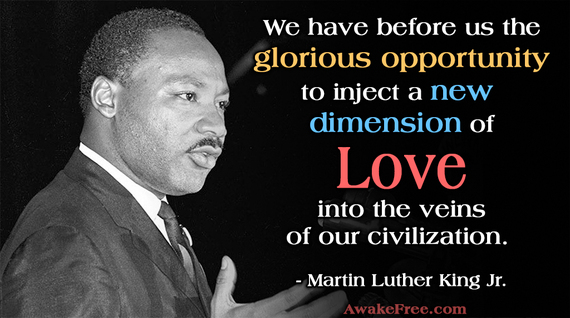
Like Dr. King, we are called to be prophets, to be witnesses of the radical, unconditional love that Jesus preached. A love that sees difference and diversity as something to be celebrated. A love that lifts up the lowly and the oppressed. A love that inspires us to work in soup kitchens, organize clothing drives, donate to charities, march in the streets. A love that will not stay silent in the face of injustice and oppression. A love that urges us to care for creation because this world is the only one we have to live in and we must preserve it for future generations. This love is neither weak nor cowardly. This is a radical love. A powerful, transformative force that is not willing to let injustice thrive. A love in which we all hold each other accountable. It is the love we hear about in the first letter attributed to John: “Let us love one another, for love is God. And everyone that loves is born of God and knows God. For the person that does not love, does not know God.” “If we love one another, God dwells in us and God’s love is perfected in us.”

We must now take up this calling to love. We must hear God’s voice in the cries and shouts of those who live in fear – in fear of losing their rights, in fear of losing their healthcare, in fear of being deported. The time is now. We cannot sit idly by when the world around us is so clearly in need.

In the words of Dr. King:

Now let us begin. Now let us rededicate ourselves to the long and bitter, but beautiful struggle for a new world. This is the calling of the children of God, and our siblings wait eagerly for our response. Shall we say the odds are too great? Shall we tell them the struggle is too hard? Or will there be another message – of longing, of hope, of solidarity with their yearnings, of commitment to their cause, whatever the cost? The choice is ours, and though we might prefer it otherwise, we must choose in this crucial moment of human history… If we do not act, we risk being dragged down the corridors of time reserved for those who possess power without compassion, might without morality, and strength without sight.

In the nearly 50 years since Dr. King preached these words at Riverside Church in New York City to protest the Vietnam War, our country has changed, but we are still in need of more change. We remain in desperate need of the revolution of values that Dr. King preached.  We live in a world in desperate need of God’s radical and unconditional love and it is up to us to be witnesses and prophets, to live out this calling of love. To continue the good work even though the road may be hard. To not give up, despite the odds. All of us here today are gathered together in love and in God’s name and we are strengthened by that. Strengthened by each other. We must not lose hope. There’s a line in the new Star Wars movie that goes “Rebellions are built on hope.” If we wish to honor the legacy of Dr. King, then we must cling to that hope, we must become that rebellion based on God’s love seeking to transform the world. The hope that is ever present in love. The hope that drives out despair. The hope that remains always. We are a people of love and a people of hope. And we shall not be overcome by the suffering of this world. We shall not be overcome by despair. We shall overcome despair with hope, we shall overcome hatred with love, and we shall keep on keeping on – working in hope, faith, and love until that when justice will indeed roll down live a river.


Amen.